
All There Is
Your life is never "not" NOW!
Joshua Fass
4/1/20266 min read

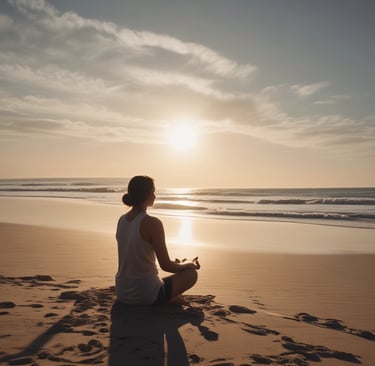
This Is All There Is (And It's Everything!)
"Most humans are never fully present in the now, because unconsciously they believe that the next moment must be more important than this one. But then you miss your whole life, which is never not now." — Eckhart Tolle
I saw it before I understood it.
A vast, open horizon. The Chobe River spreading out below me like something the earth had been quietly preparing my whole life. Hippos half-submerged. Water buffalo grazing at the bank. Egrets standing still as sculptures. Elephants moving with that slow, unhurried confidence they carry. Giraffes above it all, unbothered, feeding on acacia in the golden light.
I had walked away from our camp, alone, to a nearby lookout point. And then I just... stopped.
Not because I decided to. Because something in me simply could not keep moving forward.
I had been running for a long time before that moment.
Not literally. On paper, my life looked complete. A home in Westport. A marriage. Three kids. A career. The whole architecture of a successful life, assembled piece by piece, the way you're supposed to. Check the boxes. Hit the milestones. Keep going.
But underneath all of it lived a quiet, relentless question I couldn't silence: Is this all there is?
That question has a name. Philosophers call it the existential vacuum — the hollow feeling that arrives not in the middle of chaos, but in the middle of everything being fine. It doesn't announce itself dramatically. It seeps in at the dinner table. During the commute. In the ten seconds of silence before you reach for your phone.
I reached for something else.
Alcohol has a way of making the present moment feel softer, more bearable, more interesting than it is. For a while. And then it has another way — a slower, quieter, more devastating way — of stealing the present moment entirely. It doesn't happen all at once. It happens in increments you barely notice, until one day you look up and realize you haven't truly been in your own life for years. You've been managing it from a distance. Performing it. Waiting for it to become something that finally deserved your full attention.
I got sober. That was its own long journey, and it came with its own grace. By the time my family and I arrived in Botswana in 2018, I had been sober for five years. I was grateful for that. But sober doesn't automatically mean present. Sober doesn't automatically mean awake. I was functional. I was better. But I was still, in some way I didn't have words for yet, waiting.
And then the Chobe River.
What broke me open first wasn't the animals. It was the space. The sheer, unobstructed openness of the horizon — something I had not seen, really seen, maybe ever. In the suburbs, everything is framed. Houses. Roads. Trees. Fences. Your view is always interrupted, always bounded. You forget that the world is actually enormous.
Standing at that lookout, there was nothing between me and the edge of the world. And in that openness, something happened that I can only describe as a collapse — not of my strength, but of the part of me that had been quietly insisting, for decades, that the next moment was where my real life would begin.
It just... let go.
And what was left, in its place, was this: the overwhelming, bone-deep, almost unbearable gratitude for the gift of simply being alive. I was feeling the colors — the gold of the grass, the deep blue-green of the river, the grey of the elephants against it all. I was hearing the sounds as if for the first time. I was not separate from any of it. I was part of it. Part of the ecosystem below me. Part of the ancient, patient, indifferent, beautiful whole.
There was no self, independent of the universe. There was just presence. Just now. Just this.
I stood there for a long time.
I want to be careful here, because I know what it sounds like. An epiphany in Africa. A beautiful, exotic backdrop. Easy to dismiss as something available only to the fortunate, the traveled, the people with the resources to put themselves in front of a Botswana sunset and wait for grace to arrive.
But that's not what I took home with me.
What I took home was the understanding that the world had always been offering itself to me with that same generosity. That presence — the radical, world-dissolving kind I felt on that riverbank — is not something you have to travel to find. It is available in the texture of your ordinary day, if you're willing to stop waiting for your life to become worthy of your attention.
It's the smell of pavement after a summer rain. That particular warm, earthy sweetness that rises from hot asphalt when the first drops hit — a smell so specific and fleeting that it's almost a gift precisely because you can't hold it. You can only receive it, right then, or miss it.
It's the sound of your child sounding out a word they haven't learned yet. The slow, careful progress of a small brain making new connections. If you're half-present — scrolling, planning tomorrow, processing the email you didn't answer — you'll hear the word but miss the miracle.
It's the weight of your partner's hand in yours while you're watching something forgettable on TV on a Tuesday. Not dramatic. Not significant by any external measure. Just the quiet, irreplaceable fact of another person choosing to be next to you in the ordinary.
These are not small things dressed up as big ones. These are the big ones. This is the material your life is made of.
Tolle writes that we miss our whole lives because we unconsciously believe the next moment must be more important than this one.
I spent years living in that belief without knowing I held it. Waiting for stability. Waiting for things to settle. Waiting for the version of my life that would finally deserve my full attention. And in that waiting, I was absent from my marriage, from my children, from my own interior life. Not always. Not completely. But enough.
The Chobe River didn't give me something I'd never had. It reminded me of something I'd always been capable of — and showed me, viscerally and permanently, what it actually feels like to be here.
I am profoundly happier now. Not because my circumstances are so different, though they are better. But because I stopped waiting for them to be different before I allowed myself to show up. My relationship with my wife, with my kids, with my community, with myself — all of it has deepened in ways I couldn't have imagined when I was managing my life from the comfortable distance that alcohol, and then sobriety-without-presence, had kept me at.
You don't need the Chobe River.
The invitations are already arriving. Every single day. Most of them quiet. Most of them easy to miss. Here's what they look like for me — and I'd bet they look something like this for you too:
The salt air and the sun on your skin on a walk outside — not a destination, not a workout, just your body moving through a world that is actively, generously offering itself to your senses.
The sound of your dogs' paws on the floor when it's dinner time. My girls, Stella and Luna, have a particular rhythm to it — unhurried, hopeful, completely alive to the moment in the way that animals always are and humans rarely are. I try to learn from them every time.
An unprompted call from one of your college-age kids — not asking for anything. Just calling. If you know, you know. There is no sweeter sound.
The look on your daughter's face the moment something clicks — a stunt kite catching the wind for the first time, her hands figuring out what to do, her whole face opening into pure delight. You can't manufacture that moment. You can only be there for it.
Reading your daughter's poetry — words she chose carefully, images she built from the inside out — and realizing that this person came from you, and became entirely herself, and has something beautiful to say about the world.
The smell of dinner coming together — garlic hitting a hot pan, something roasting low and slow — and the knowledge that your hands are making something that will nourish the people you love most. It is one of the oldest human acts. It deserves your full attention.
None of these moments announce themselves as significant. That's precisely the point. They don't arrive with fanfare or a sense of occasion. They just arrive — and then they're gone — and the only question is whether you were there to receive them.
Your life is never not now.
If any part of this resonated with you, I'd love to hear it. We're all, in our own ways, learning how to show up.